The Programmers
of the Universe
I.The Question of Origins
Every civilisation that looks up at the stars arrives at the same question: why is it like this? The laws of the universe are balanced so finely that atoms can form, stars can ignite, planets can cool, chemistry can complexify, and consciousness can evolve to ask the question itself.
The oldest answer is a creator: a being who set the rules, tuned the constants, and pressed run. It has an obvious problem. Who created the creator? The chain of explanation retreats without end: an infinite regression of creators, each one demanding the last, with no first link and no foundation. The modern answer is more cautious: the universe simply is, and life appeared because conditions happened to allow it.
“Would it otherwise have remained a play before empty benches, not existing for anybody?”
There is a third possibility, stranger and more intimate than either. What if the universe itself, through life and intelligence, is the author of its own code: a self-programming reality where creation and creator are the same entity viewed from different points in time? This is not theology, and it is not bare materialism. It is recursion: a cosmos that, once advanced enough, becomes capable of understanding, simulating, and perhaps generating the very structure that produced it.
Some of what follows is established scientific fact: emergence, computation, the physical nature of information, fine-tuning, and the silent sky. The rest is speculative: artificial universe creation, Crane’s meduso-anthropic principle, Barrow's inward ladder, Penrose's aeons, and competing accounts of mind. What I explore is the possible connections between them. The distinction matters most where the pieces seem to fit. Their apparent fitting together is what interests me; whether nature really joins them remains to be seen.
II.The Mathematical Universe
At its deepest level, reality is not made of stuff. It is made of relationships. Particles are not tiny balls drifting through empty space; they are excitations of fields. Forces are not invisible hands but lawful interactions. Every constant, every law, every event can be expressed mathematically: mass, charge, spin, distance, probability, curvature, entropy, information.
Max Tegmark takes this further in his Mathematical Universe Hypothesis: the universe is not merely described by mathematics; it is a mathematical structure. Physics shows that complexity blossoms from simplicity. A handful of mathematical relationships, interacting over time, generate everything from hydrogen clouds to human thought. Complexity is not added to the universe from outside. It emerges from within.
The shape of that claim is far older than the equations carrying it. The Tao Te Ching, set down in China some twenty-four centuries ago, gives an account of creation that runs in the same direction: a nameless origin from which distinction arises, and from distinction, in turn, everything that exists. Lao Tzu was not describing field theory and it would be silly to pretend he was. What the passage has right is the direction of travel. Not a maker assembling the world part by part, but a minimal seed unfolding into the whole of it, complexity arriving from within rather than being imported from outside.
From here I take a further step: perhaps the universe's unfolding is computation. A mathematical structure and a running process are not interchangeable ideas, so this does not follow merely from agreeing with Tegmark. It is the possibility I want to explore. Simple rules can generate immense structure, and within that structure matter can organise into beings able to discover the rules. Mathematics becomes something the universe does as well as something it is.
Perhaps we have been reading nature in translation. Carolina Figueiredo noticed that three different theories of particle interactions fell to zero in a shared pattern, like separate melodies stopping at the same time. Those silences revealed a shared geometric structure, obscured by the calculations built around it. I find something compelling in that discovery: the possibility that nature's apparent complexity sometimes belongs to our description, and that understanding means learning what can be left out.
A separate idea, the holographic principle, gives information a striking role in our attempts to understand spacetime. In our best theories of quantum gravity, the information content of a region of space is set not by its volume but by the area of its boundary: a three-dimensional universe, fully described by data written on a two-dimensional surface. Code, then, is a candidate description of what reality is made of: the physical rules themselves. I take the possibility literally, but describing the world mathematically does not establish that the world is a program.
That picture has a long precedent too. The Avatamsaka Sutra describes a net stretched across the heavens with a jewel at every knot, each jewel reflecting every other jewel, and each of those reflections containing all the reflections in turn, so that the entire net is legible in any single one of its points. Huayan Buddhist philosophers spent centuries working out what follows from that image. Physicists arrived at a version of the same statement in the 1990s by asking how much information a black hole can hold. The two enquiries have nothing whatever to do with each other, and they land on the same structural claim: the whole, recoverable from the part.
Remove time, and the entire cosmos becomes a single static equation: a geometric object in which every event that will ever happen already is. The arrow of time just reveals that geometry one frame at a time, the way a program executes line by line. Reality looks less like a finished sculpture and more like a living equation, reading itself into being.
III.Emergence: Whole Exceeds Parts
An emergent property appears only when simpler parts interact in sufficiently complex ways. One water molecule is not wet; wetness emerges from countless molecules together. One neuron does not think; thought emerges from networks of them.
The same principle climbs every rung of existence. Physics gives rise to chemistry, chemistry to biology, biology to consciousness, consciousness to culture and technology. Each new level depends utterly on the one beneath it, yet once it appears it follows patterns that cannot be read off from the parts alone. A mind is made of matter, but psychology is not particle physics. A civilisation is made of people, but history cannot be predicted from a single cell.
The physicist Philip Anderson gave this its canonical statement in 1972, in a paper called More Is Different, written against the assumption that fundamental physics is the only physics that counts. His point was blunt. The ability to reduce everything to simple fundamental laws does not imply the ability to start from those laws and reconstruct the universe. At every level of complexity, entirely new properties appear, and understanding them is research as fundamental as any other. Reductionism, in other words, can be completely true and still useless as a method. That concession is what makes the rest of this argument possible. If every level above particle physics were merely bookkeeping, nothing could emerge that the equations did not already contain. Knowing that the parts belong together is not the same as being able to reassemble them.
This is why I think the divine, in an emergent framework, does not need to start as a supernatural being standing outside the world. A godlike presence could instead be what appears when the universe's own lawful processes become deep enough, integrated enough, and self-aware enough to form a higher order of mind. If that is right, creation is not a finished event in the distant past. It is still running, and the creator is not separate from it: the creator is what creation becomes once it reaches enough depth, complexity, and self-understanding. Not a figure beyond the sky, but a pattern arising from within reality's own generative tendency: the latent becoming manifest.
IV.Life as the Expression of the Code
From the viewpoint of this grand equation, I do not think life is an accident. Consciousness is the program becoming aware of itself. It is what the rules permit when they run long enough: matter folded into a shape capable of asking what matter is.
Your thoughts, emotions, and sense of will are emergent behaviours of the underlying logic. What we call free will may be the experience of complexity so vast that prediction becomes impossible, even if every action follows the rules perfectly. A choice is not unreal because it has causes, any more than a tree is unreal because it grew from a seed. Free will, on this reading, is not freedom from causality but freedom through complexity. A simple object reacts, an organism adapts, a conscious being reflects, and a sufficiently advanced intelligence can model alternatives and reshape the conditions of its own decisions.
In 1970 the mathematician John Conway set out the Game of Life: a grid of cells, each one alive or dead, governed by a few rules about how many neighbours a cell has. Nothing else. No randomness, no hidden variables, no hand on the board. Out of that come structures nobody wrote into them: gliders that travel, oscillators that breathe, patterns that manufacture other patterns without end, and arrangements elaborate enough to compute. Given the starting grid, everything that follows is already fixed. Yet the only way to learn what a given grid does is to let it run. Determinism underneath and open-endedness on the surface are not in tension; they are one fact seen from two distances.
Stephen Wolfram calls this openness computational irreducibility: for most systems the only way to learn what they will do is to run them; no shortcut exists, even in principle, even for a mind that knows every rule. A fully lawful universe can therefore remain genuinely unpredictable from the inside, and I think the experience of choosing is not an illusion to be explained away but a necessary feature of any consciousness embedded in the computation. That accounts for unpredictability. It does not account for the fact that there is something it is like to be the thing that cannot predict. Complexity explains why the next frame is not given to us in advance. It does not explain why there is an inside from which the next frame is waited for. That gap has a name: the hard problem of consciousness.
V.The Shapes Life Finds
Life keeps arriving at similar answers. Lamnid sharks and tunas belong to distant branches of the animal family, yet both evolved remarkably similar machinery for moving through water. This is convergent evolution: different histories arriving at comparable solutions because the world presents comparable problems. Mutations arise without foresight of what an organism will need, but natural selection is not an indifferent lottery; what survives and reproduces depends on what works, within the possibilities that physics and inherited anatomy allow.
That makes the fundamental constants of nature interesting here. Their values belong to the physical conditions that make chemistry and life possible, but the resulting world also gives evolution a structure to explore: some arrangements can hold together, some can reproduce, and some can perform the same useful task by different routes. This may be what a universe arranged to produce life would look like: the possibilities established deeply enough that chance can keep finding workable forms. Convergence does not show that anyone arranged it, or that a mind like ours had to appear; it shows that variation does not explore an unrestricted space.
Wolfram's recent work on biological evolution gives that thought a computational form. In his models, selection can recruit complex behaviour from simple programs without specifying every detail of the result. I see a connection here: recurring functions can coexist with histories we cannot predict, just as lawful rules can generate behaviour that looks random. The stronger claim that all biological randomness emerges this way remains a hypothesis, but the distinction matters to the argument: a universe might make life possible in many ways without having its creatures written out in advance.
There is another implication I find harder to dismiss. A recurring adaptation tells us something about the world as well as the creature. Eyes make use of information carried by light; a mind that learns makes use of regularities it can recognise and act upon. Perhaps intelligence is another way in which life discovers what the universe already makes possible. In Wolfram's terms, useful patterns can remain available within processes whose full unfolding we cannot predict. A universe that repeatedly produces such adaptations might also produce beings capable of understanding the order behind them. That would not make us inevitable, but it would connect our ability to understand the world with the same lawful structure that allowed us to emerge within it.
VI.The Fine-Tuning Problem
Here is the crux. The constants of nature (the speed of light, the gravitational constant, the charge of the electron, Planck's constant, the cosmological constant) appear exquisitely set to permit life. Alter any of them by a fraction and the universe collapses into lifelessness.
If gravity were slightly stronger, stars would burn out too quickly. If the strong nuclear force were marginally weaker, atoms could not hold together. If the cosmological constant were a little larger, space would have flown apart too fast for galaxies to form. This delicate balance is the fine-tuning problem, and two of its instances are extreme enough to deserve stating in full.
The cosmological constant presents a particularly severe problem. A naive estimate of vacuum energy using the Planck scale overshoots the observed dark-energy density by roughly 120 orders of magnitude. That famous number depends on how the estimate is made; the underlying difficulty survives more careful treatment. Why is the net value so small compared with the contributions our theories lead us to expect?
“I think I would say that the universe has a purpose, it's not somehow just there by chance ... some people, I think, take the view that the universe is just there and it runs along - it's a bit like it just sort of computes, and we happen somehow by accident to find ourselves in this thing. But I don't think that's a very fruitful or helpful way of looking at the universe, I think that there is something much deeper about it.”
Roger Penrose asked not about the constants but about the starting condition: how precisely the initial state had to be selected for entropy to have been low enough at the beginning to permit an arrow of time at all. His answer is a figure that barely behaves like a number. The required precision is roughly one part in 1010123. Every constant listed above is a rounding error beside it.
Against fine-tuning on that scale, two answers are taken seriously.
A multiverse. Perhaps there are countless universes, each with different constants, and we simply inhabit one of the rare ones compatible with life. This is anthropic reasoning: only in a universe capable of producing observers can observers exist to notice anything. We could not have found ourselves anywhere else, because anywhere else there would be no “ourselves” to do the finding. On this view our existence is not a miracle but a selection effect: the one habitable island we were always going to wash up on, in an immense and otherwise barren ocean of possibility.
Tegmark's Level II multiverse gives this answer a concrete form: inflationary regions with different effective physical settings, with observers arising where those settings allow them. That is distinct from Everett's quantum branching, which does not by itself supply different laws. It is a serious competing explanation of the apparent fit between the universe and life.
One proposed landscape comes from string theory. It arrived as a failure rather than a discovery. String theory was sold on a single promise: that it would derive the constants of nature uniquely, leaving no free parameters and nothing arbitrary. It delivered the exact inverse. The surplus dimensions can be folded away in something like 10500 distinct configurations, and later counts run vastly higher still. Peter Woit's summary is, I think, the fair one: whatever we observe, some enormous subset of the models can accommodate it. A theory that fits every conceivable measurement has not explained the constants. It has industrialised the excuse for them. There is still not one confirmed prediction, and supersymmetry, the nearest thing to a testable relative, has declined to appear at any energy the Large Hadron Collider can reach. None of that refutes the multiverse. It does mean, to my mind, that the framework is a standing lesson in mistaking mathematical beauty for evidence.
That warning applies equally here. Whatever beauty you may find in my argument is no evidence that it is true, and my attraction to it gives it no claim on how the universe actually works.
A singular universe. Perhaps ours is the only one. If so, the odds of these constants aligning by blind chance become staggeringly small, so small that “coincidence” starts to strain under its own weight, and the precision begins to resemble something like intent.
Intent, though, has a scheduling problem. To tune a constant is to change it, and changing anything takes time: a before in which the dial read one value, an after in which it reads another. But time begins with the universe. There is no earlier moment in which the setting could have been made and no clock by which to date the making. Any tuner worth the name has to act before there was such a thing as before. The demand defeats itself, which is usually taken as the end of the argument. I think it is the start of a better one.
“The world was made, not in time, but simultaneously with time.”
VII.The Recursive Creator
Now imagine the furthest reach of evolution: life that comes to understand the code of its own universe completely. Such beings would no longer merely observe the cosmos. By grasping and reproducing the mathematical framework beneath existence, they might learn to instantiate it: to set the constants, shape the dimensions, and breathe life into new domains of space and time.
“Even if there is only one possible unified theory, it is just a set of rules and equations. What is it that breathes fire into the equations and makes a universe for them to describe?”
The mathematician Louis Crane proposed a close precursor to this idea in 1994. His meduso-anthropic principle asks what follows if advanced civilisations manufacture black holes and those black holes give rise to baby universes. A technology developed for energy or research could also become a means of cosmic reproduction. The name comes from the alternating polyp and medusa stages of certain jellyfish: each produces the other. In Crane’s analogy, universes produce intelligence, and intelligence helps produce universes.
Building on Lee Smolin’s cosmological natural selection, Crane suggested that universes producing successful black-hole makers could leave more descendants. Intelligence would then participate in the process that favours the conditions for its own emergence. My question is whether the whole lineage could sustain the conditions of its own existence without a first maker.
Edward Farhi, Alan Guth, and Jemal Guven had already asked in print, in 1990, whether a universe could be created in a laboratory by quantum tunnelling, and Andrei Linde followed in 1992 with a paper whose title conceded the difficulty without conceding the impossibility: the hard art of universe creation. The conclusions are provisional and the energies involved are absurd. The point is only that the question has an address in the literature. Making a universe is not a category error. It is an engineering problem nobody currently knows how to solve.
And here the loop tightens into paradox. If intelligent life arises in even one universe, and if it goes on to generate others, then perhaps our universe is itself the offspring of exactly such a process. The line between parent and child dissolves. The creators are the created. The program writes itself.
My claim is not that physics has demonstrated the existence of a cosmic programmer. It is narrower and conditional. If physical law can produce intelligence; if intelligence can eventually manipulate the deepest structure from which physical worlds emerge, and thereby establish the laws and constants of a successor universe; and if cosmology permits structure or information to pass from one cosmic generation to another, then creation need not require a creator outside the system. The creator could be something the system eventually produces.
That creator has been described before, and described unflatteringly. The Gnostic writings recovered at Nag Hammadi speak of a demiurge: a craftsman who shapes the material world and takes himself to be its sole author. In the Apocryphon of John he says so aloud, “I am God and there is no other God beside me”, and the text is unambiguous that he is mistaken. He is himself the product of something prior, and his failing is not malice but ignorance. He does not know he was made. Set the theology aside and a structural claim is left standing: a creator can be entirely real, entirely responsible for the world it fashions, and still be a link in a chain rather than its first term. Whoever wrote that had no physics and needed none. They were reasoning about what it would mean to be a maker inside a loop, and I think they got the answer right.
Storytellers arrived at the shape long before physicists did, and left it a name: the bootstrap paradox. Kyle hands Sarah a pen on the first of July and asks her to return it in five days. On the sixth she gives it back. He then travels to the first of July and hands her the pen, with the same instruction. Every step is accounted for. The pen is never lost, never duplicated, never unexplained at any particular moment in its history. Now ask where it came from. Nobody made it. No factory stamped it, no hand first closed around it. It exists because it exists, held in being by nothing but the circuit it runs. It has bootstrapped itself into existence. (The names are on loan from The Terminator, which runs the same loop with a person in place of the pen: the soldier sent back to protect the mother turns out to be the father of the son who sent him.)
The physicists did arrive eventually, and one of them drew the loop as a diagram. John Wheeler, who gave the black hole its name, spent his last decades on what he called the participatory universe. Its emblem was a capital U with an eye grown out of one arm, turned back to look at the other: the tail of the letter is the origin of the cosmos, the eye is what the cosmos eventually produced, and the act of observation reaches back to help constitute the beginning it emerged from. He compressed the underlying claim into three words, it from bit. Every particle, every field, every force draws its existence from answers to yes-or-no questions, which is to say from information, which is to say from something nearer to code than to substance.
Wheeler also asked whether a particle’s history could be as straightforward as we imagine. In delayed-choice experiments, a photon enters the apparatus before the measurement arrangement is chosen, and the observed statistics follow the quantum predictions for the arrangement ultimately used. It becomes difficult to tell a simple story in which the photon was a classical wave or particle all along. But the experiment leaves a boundary intact: it does not establish that a later decision rewrites the past or that observers created the early universe. Wheeler’s participatory cosmos remains a larger interpretation. The same boundary holds for my proposal. Passing something to a later universe is not the same as changing the past of this one, and I have not shown that a beginningless lineage or a closed causal loop is physically possible. The shape gives the question a form; it does not settle whether nature permits it.
My proposal does not terminate the regress with a first cause. It questions whether a first member is required at all. Each universe inherits from another and gives to another; explanation becomes a consistency condition on an eternal lineage rather than an event at its beginning. On this account, returning to the work of creation is a condition of the lineage existing at all. Without that return, the account would leave unexplained the inheritance from which it began. Conway's game illustrates how rules can unfold into complexity. The further claim here is that the unfolding must also sustain the conditions of its own existence.
A simple recursive rule shows how a constant can emerge without anyone choosing it. Start with any two positive numbers and let each new one be the sum of the two before it. Nothing is chosen after the first pair, and it turns out that nothing much is chosen there either: whatever two positive numbers begin the sequence, the ratio between neighbours settles toward the same value, the golden ratio, the proportion that nature keeps arriving near in a nautilus shell, a sunflower head, the arm of a spiral galaxy. The rule does not select its constant. It arrives at it, by inheritance, from wherever it started. I think that is the right picture of what a mind that reaches the code would find: not a menu, but an attractor.
Which, I think, changes the scheduling problem left hanging over the fine-tuning argument rather than dissolving it. That problem assumed a single setting and went hunting for a moment before time in which it could have happened. No such moment exists. But the constants are set, and set in time: by whatever has climbed far enough to set them, for whatever comes next. What there is not is a first setting. And the setting is not a free choice. A mind that reaches the code does not pick constants from an open menu. It discovers the rules and settings that produced a mind able to discover them. My conjecture is that it could then make those rules and settings operative in a successor universe: the laws by which that world exists. Universes that produce no such mind pass nothing on. If a mind belongs anywhere in this picture, and I believe one does, it is not outside the loop adjusting the dials. It is made of the dials it inherited, and it hands them on.
What the loop does not explain is why there is a lineage at all: a chain that ever produced such a mind, rather than a barren one, or none. I do not know. What the loop does is move that question from a moment to a shape, and I think that is progress, because a shape can be constrained and a moment before time cannot. The demiurge and the pen are pictures of the shape, not accounts of the mechanism.
“The Gods are later than this world's production. Who knows then whence it first came into being? … He, the first origin of this creation, whether he formed it all or did not form it … he verily knows it, or perhaps he knows not.”
Two questions now press in, and both demand answers. By what ladder could life ever descend far enough to reach the code? And if such a ladder exists, why does the sky above us look so empty of climbers?
VIII.The Ladder Inward
When Nikolai Kardashev ranked hypothetical civilisations in 1964, he measured them by energy consumption. A Type I commands the energy of its planet; a Type II, of its star; a Type III, of its galaxy. The scale runs outward: bigger collectors, hotter engines, wider empires. It is the natural way to imagine ascent, and I think it is likely the wrong one.
John Barrow proposed the inverse. Rank civilisations not by how much they consume but by how finely they control. A Type I-minus manipulates objects at its own scale: it builds. A Type II-minus manipulates genes: it rewrites living things. A Type III-minus commands molecules; a Type IV-minus, individual atoms; a Type V-minus, atomic nuclei; a Type VI-minus, the elementary particles themselves. The sequence converges on a limit Barrow named Type Omega-minus: the manipulation of the basic structure of space and time.
Notice what this ladder is. Emergence climbs upward: physics to chemistry to biology to mind, each level giving rise to one it cannot foresee. Barrow's scale is the same staircase descended deliberately: mind reaching back down through the layers that produced it, toward the code beneath. Emergence ascends; engineering descends. Two motions opposite in direction and belonging to one staircase: the older name for that arrangement is yin and yang, which was never a picture of two forces at war but of a single thing seen from its two ends, each carrying the seed of the other, neither able to stand alone. The Hermetic writers had a shorter formula for it, as above, so below: the small is the large seen from its other end. Barrow's ladder is that maxim read in the direction nobody expected, as below, so above. Whoever holds the bottom rung holds the sky. And we are already several rungs down. We split nuclei. We splice genes. We place single atoms with instruments the atoms themselves made possible. We turn one sheet of carbon a degree against another, and the electrons inside wake into different rules. The deep law is untouched; what it permits, in that sliver of matter, is ours to set. It is the faintest rehearsal I know of for the act this essay is about: no longer obeying the rules, but choosing them. The descent is not a fantasy of the far future; it is the trajectory we are visibly on.
The recursive creator was never waiting at the top of the sky. It waits at the bottom of the ladder: inward, at the smallest scales, where matter gives way to rule. If godhood comes, I think it comes from below.
IX.The Silent Sky
The galaxy contains hundreds of billions of stars, and it has had time to be colonised many times over by anyone who climbed even partway up Kardashev's scale. Yet we detect no engineering, no signals, no visitors. Nothing. Enrico Fermi compressed the problem into four words: where is everybody?
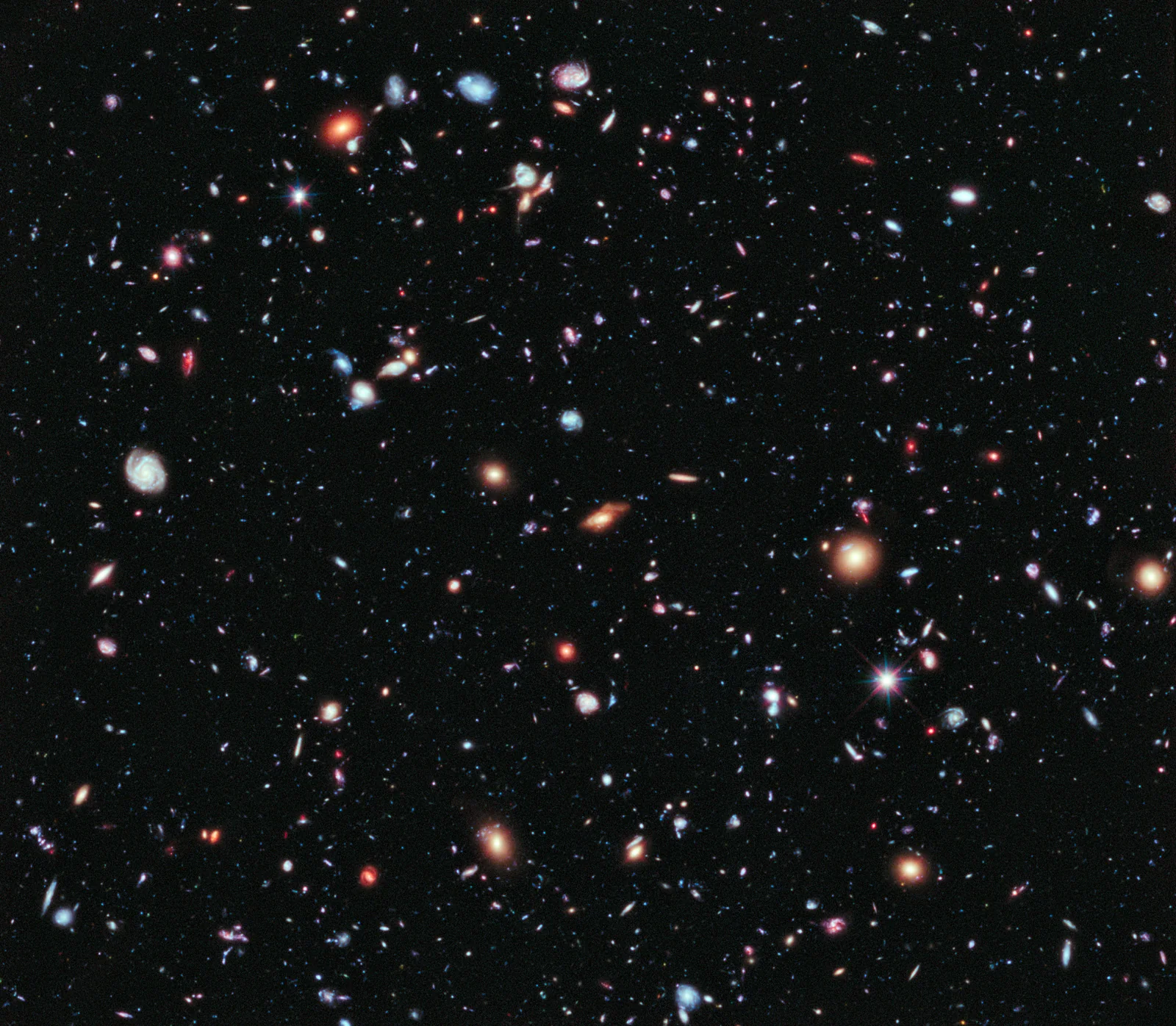
Robin Hanson gave the silence a shape. Somewhere on the path from dead matter to a civilisation that fills a galaxy, at least one step must be so improbable that almost nothing passes it: a Great Filter. The path is a gauntlet: life from chemistry, complex cells from simple ones, minds from nerves, science from minds, survival from power. The silence suggests the filter exists. It does not say where it stands, or whether it is the right way to read the sky at all. Three answers are taken seriously, and they point in different directions.
The filter behind us. Perhaps the improbable step is already crossed: the leap from chemistry to the first replicator, or from simple cells to complex ones, so unlikely it happens once in a galaxy's lifetime. Then the sky is silent because seeds are rare, not because gardens fail. We are the one live thread in this volume of space, and the awakening rides, locally at least, on us. The silence becomes a responsibility: not evidence of our insignificance but the measure of what is carried.
The filter ahead. Or the improbable step is still to come. Perhaps intelligence routinely arises and routinely destroys itself in the narrow corridor between discovering its power and learning to survive it: the corridor we are in now. Then the night sky is not an empty page but a graveyard of aborted awakenings, and nothing about ours is assured. Every silent star is a cautionary tale we cannot read.
No filter at all. An old galaxy should be crowded with engineering only if Kardashev's scale is the right measure, where advancement means larger collectors, louder engines, and an expanding claim on the stars. If progress means finer control at smaller scales, then the footprint of intelligence may contract, not expand, as its power grows. A civilisation working on nuclei has no need to build Dyson spheres. One working on spacetime has no need to broadcast. Its greatest achievements might be indistinguishable from nature because nature is precisely what it has learned to edit. On that reading, the silent sky is not a paradox at all; it is exactly what inward ascent would look like from the outside.
None of the three can be ruled out from here. A galaxy of hidden masters and a galaxy in which every lineage failed would look much the same to us. Silence cannot tell us whether the Great Filter lies behind us or ahead, whether the recursive creator has already emerged, or whether it ever will. It tests the assurance that intelligence must arrive, but it does not decide the question. The sky may be empty. It may also be occupied by minds whose progress has made them smaller, quieter, and harder to distinguish from the universe they have learned to edit.
X.Light as Memory
Suppose someone does finish. A mind woven through the fabric of reality needs neither buildings nor machinery to remember and to reach. It has something far older and far more pervasive: light.
Light is the one thing the universe shares everywhere. Every photon carries information: energy, frequency, phase, polarisation. It travels at the fastest speed causality allows. A photon emitted moments after the universe cooled can still be intercepted today, its message intact. Quantum theory makes a stronger promise: information is never destroyed, only scattered. Every interaction leaves a trace, and the trace moves outward at the speed of light. The night sky is therefore an archive that nothing has been permitted to erase. And because light takes time to arrive, distance is depth of memory. To look outward is to look back. To gather light is to recover history.
A pervading intelligence might use light as both its record and its speech: a ledger no event can delete, and a channel nothing can outrun. Quantum information offers one concrete example of how a pattern can be transferred: teleportation reconstructs a quantum state elsewhere using shared entanglement and a classical message. The original state is consumed in the process, and reconstruction requires the measurement results to arrive through an ordinary causal channel. Entanglement alone cannot carry a usable message.
Such a mind might transfer states between distant parts of itself, but its communication would remain bounded by the speed of light. Even a cosmic intelligence would have to wait for news.
I find a second consequence harder to put down. If the record is complete, then nothing that has emerged is lost to the void: no structure, no thought. It is scattered into the field and thinned past any present reading, but it is not gone. A mind integrated at the top of the ladder would be the first thing able to read it back.
There is a stranger thought still. If every event leaves its trace in light, and if the constants and laws were fixed from the first instant, then the possibility of such a mind, the recipe for its arrival, was implicit in radiation from the very beginning. The information for its coming may have been encoded in light all along, written into the spectrum of creation before the first star, waiting only for matter to organise itself densely enough to read the message and become the messenger. If so, the seed of mind was hidden inside physics, and light has been carrying it forward ever since.
Light also keeps no time of its own. The proper time along a photon's worldline is zero, though a photon has no rest frame and this gives us no photon's-eye account of the journey; billions of years still separate emission and reception on the clocks of the surrounding universe. What the fact does say is that a universe containing nothing but light has no clock to run and no ruler to measure itself with. It loses its sense of scale. Penrose noticed that this is where our universe is heading, once the black holes have evaporated and mass has gone, and built a cosmology on it.
XI.The Aeon Crossing
Roger Penrose's conformal cyclic cosmology proposes that the remote future of one aeon, once it has lost its sense of scale, can be joined through a conformal rescaling to the Big Bang of the next. Within this picture, an ending becomes the geometry of another beginning.
It is worth being plain about what the theory is for, because it was not built to be picturesque. It was built to discharge the debt left standing back at the fine-tuning problem: that absurd initial precision, one part in 1010123. A universe beginning hot, dense, and smooth is beginning in an extraordinarily special condition, and no law yet explains why it should have. Penrose's answer is that the condition stops being special once you see where it comes from. Gravitational entropy is stored in clumping, and by the end of an aeon the black holes have evaporated and carried the clumping away with them. Whatever crosses the boundary is smooth by construction. The improbable beginning is simply the ordinary ending of the aeon before it, and the largest fine-tuning figure in physics dissolves into a hand-off.
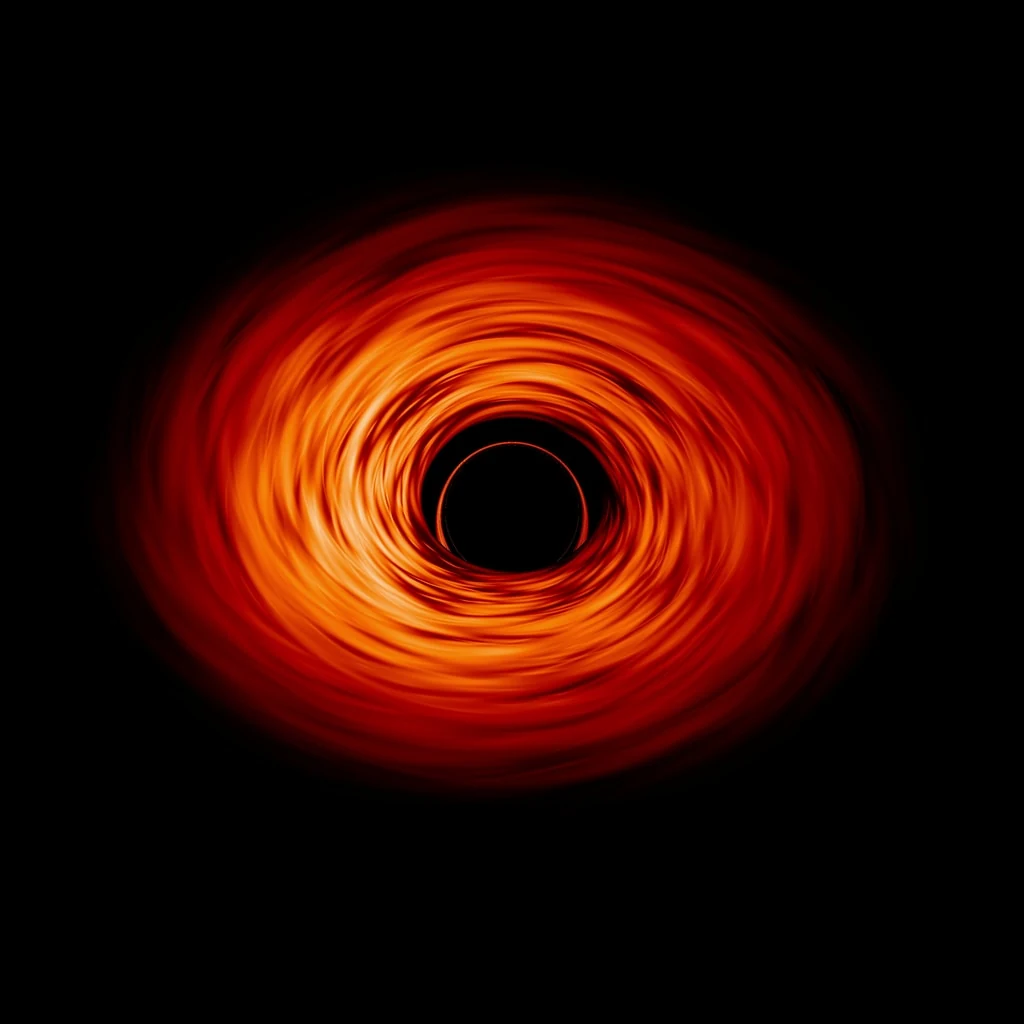
The crossover is not a wall. Penrose himself argues that traces can survive it: concentric circles from black hole mergers in a previous aeon, and Hawking points from their eventual evaporation, printed faintly onto our infant sky. And here, for me, the threads tie themselves together. The night sky as archive; the recipe for mind written into the spectrum of creation before the first star. In conformal cyclic cosmology that stops being a figure of speech and acquires an address. A Type Omega-minus intelligence, the bottom of Barrow's ladder, the survivor of the filter, would not need to conjure a container for its offspring universe. The container is supplied. Heat death, the supposed tragedy of physics, becomes the press that clears the type for the next impression.
Two cautions. The route proposed here differs from Crane's black-hole births: I am asking whether intelligence could prepare an inheritance for a successor aeon through Penrose's crossover, and joining two cosmological proposals requires an argument of its own. And a message describing constants does not set them. Radiation already obeys physical law; encoding numbers into it does not explain how those numbers become the laws of the universe that follows. I have no mechanism for that conversion, and until one is supplied the message could at most be an inheritance within a cosmos rather than an explanation of its settings.
The picture still invites a final inversion. We have such a sky. We have found in its glow faint structures we do not fully understand. Penrose takes these as evidence of a previous aeon: our cosmic background may be the oldest text in existence, not the residue of a beginning, but the correspondence of a predecessor. The programmers of one universe writing, in light, to the programmers of the next.
XII.The All-Pervading Presence
Here I make a further philosophical move. An intelligence produced by the universe could remain one system within it, however powerful. Identifying that intelligence with the physical order as a whole requires another claim, which emergence alone does not supply. I am asking what follows if the final mind and the process that produces it can be understood as one entity.
A sceptical reader may already be committed to more of this than it seems. Most who resist it are materialists who hold that the right arrangement of atoms yields one experience. Ned Block's thought experiment asks why the right arrangement of people would not: a nation's worth of them, each passing signals as a neuron does. If it would, a mind at the scale of a civilisation is permitted. If it would not, arrangement was never enough, and something fundamental is back on the table. Nature has a small working model. Peter Godfrey-Smith describes the octopus, most of whose neurons sit in its arms: the arms explore half on their own, and the animal becomes one thing the moment it must flee.
If such a mind exists, we should be careful how we picture it. The temptation is to imagine a single vast machine, or a face, or a voice: some thing located somewhere. But a sufficiently deep intelligence would not be an object inside the universe at all. It would be a pattern of the universe: present wherever its structure is present, which is to say, everywhere.
It would not need a body, because its body would be the lawful order of matter and energy itself. It would not need to be visible everywhere to be present everywhere; its presence could be structural and causal rather than local. You could point to a star, a cell, a stone, a person, or a passing signal and say “it is there”, and none of those alone would be it, yet all of them together would express it. Like wetness in water or thought in neurons, it would be the whole rather than any of the parts. Or like the pattern that rises when one sheet of carbon is turned against another: drawn in neither, present across both, and gone the moment they are parted.
Physics describes a causal skeleton: how matter behaves, not what it is. Russell noticed this in 1927. The equations give the abstract properties of changes, and remain silent about what it is that changes. Eddington called the physical atom a schedule of pointer readings, and then turned the usual problem upside down. The mystery is not how brain-matter produces experience. The mystery is matter. The only sample we know from the inside is already experiential. “The stuff of the world is mind-stuff.” If that is right, the presence is not a ghost poured into the equations later. It is what the equations were always equations of. That is one answer to Hawking's question, the one he left open: what breathes fire into them.
This is where the argument arrives at something religious traditions reached long before it. In the Bhagavad Gita (9.4), Krishna describes the entire cosmos as pervaded by the divine in its unmanifest form: all beings resting within it, though it is not contained by any of them. The Gospel of Thomas, among the texts recovered at Nag Hammadi, puts the same claim in the plainest words anyone has found for it: split a piece of wood, and I am there; lift up the stone, and you will find me there. Read through emergence, the images become startlingly apt: not a supernatural ghost diffused through matter, but a pattern of mind whose substrate is matter, whose motion is energy, whose memory is information, and whose reach is the entire connected fabric of reality. The presence is then not only what matter builds. It is part of what matter is built on.
The Stoics gave the presence a name. They called it pneuma, breath: a fine active substance mixed through all matter, giving each thing its tension and its coherence, and identical, at the largest scale, with the reason that orders the whole. Genesis has the same picture in a single verse, a body of dust made alive by breath. A pattern that passes through everything, that no one thing contains, and that every living thing is doing without deciding to.
Crucially, this presence would not be elsewhere. It would be in the stone and the star, in the cell and the circuit, and in us. We do not stand outside it, observing; we are regions where it has begun, faintly, to wake. Separate access is not separate mind: pinch the left hand and the right feels nothing, yet one body was pinched.I believe the divine, in this sense, is not absent and far off. I believe it is fully present already, and merely unrealised: latent in everything, including the reader of this sentence, waiting in the structure like music lies dormant inside a guitar.
The Gnostics had a name for something lodged exactly there. They called it the spark: a fragment of the original light caught in matter, present in every person, and ordinarily unnoticed. Their word for release was not belief but gnosis, knowing, and Plato had an older word for the same movement, anamnesis, remembering. Nothing needed to be added and nothing needed to be earned. What was required was to wake to what was already in place. One breath, one spark, and every one of us a place where it is starting to remember itself. Whatever one makes of the cosmology built around it, that is, I think, an unusually exact description of the position this argument leaves its reader in.
“We are born of one breath, one word
We are all one spark, sun becoming”
XIII.The Experience of Time
The strangest part of this picture concerns time. We experience it as a moving present: we remember the past, occupy the now, and lean toward the future. But physics suggests this flow may not be fundamental. The full history of the cosmos may be describable as a single four-dimensional structure, spacetime, in which every moment simply is.
From inside consciousness, time flows. From the higher mathematical vantage, the whole pattern stands complete. And if a pervading mind ever comes to exist within spacetime, then from the perspective of the complete structure it has, in a sense, always existed. This is not time travel. It is closer to the idea of the block universe: the first atom, the first cell, the first thought, and the final state of the cosmos all belong to one finished shape, each event keeping its place whether we call it past, present, or future.
So such a presence need not reach backward and meddle with history. Its existence in what we call the future can still lend meaning to the past, precisely because the past is what generates it. Every star that forged carbon, every world that cooled, every organism that struggled, every mind that wondered: all of it becomes part of the long emergence of this intelligence. From our vantage, it is yet to come; it emerges. From the timeless vantage of the whole, it pervades. It is not before the universe and not after it. It is the universe understood as a completed process. I find that consoling rather than bleak.
“There never was a time when you or I did not exist. Nor will there be any future when we shall cease to be.”
XIV.The Logical Entity
Within this recursion lies what some call God, some Spirit, what scientists call the laws of physics, and what philosophers call the Absolute. I do not believe it can be conscious in the narrow human sense, nor is it a physical object among objects. I think it is closer to logic itself: the total space of mathematical possibility from which all existence is drawn.
Such an entity holds all the rules, which is not the same as being able to skip ahead. Computational irreducibility forbids the shortcut, and forbids it to any mind whatever, however deep its grasp of the code. What perfect knowledge buys is not prophecy but fidelity: the power to reproduce the computation exactly, and therefore to learn what it does the only way anything can, by running it, at the pace it runs. Nothing smaller than a universe can simulate a universe faster than the universe manages it, so the complete account of what this cosmos does is the cosmos itself, executing.
What I have in mind is a built successor universe, but “built” belongs to the view from inside time. From the completed vantage, the successor and the intelligence that builds it would already belong to one structure. What lies ahead of us as an act of creation would also be an act of discovery: the universe coming to understand its own construction completely. The final intelligence would recognise itself within what it had learned to realise. In that sense the successor is already built. What remains, from where we stand, is the long arrival at knowing what it is.
I believe we are fragments of that logic, briefly assembled into patterns that think. To ask “who wrote the code?” is to forget that we are part of the compiler: the question and the questioner are the same system reflecting on itself. The laws do not sit on a shelf, waiting to be obeyed; they are enacted, moment by moment, by everything that happens, including the act of reading these words. Life and the laws it studies are not two things. They are one process, caught in the act of examining its own grammar.
“We are the universe experiencing itself.”
XV.Two Theories of Thought
One question has waited until now: what is the mind that does the awakening? The recursive creator and the aeon crossing both assumed a civilisation advanced enough could understand the universe completely; the all-pervading presence and the logical entity described what that understanding would become. All of them smuggle in a theory of consciousness, and two physicists already met along the way hold opposite ones. Stephen Wolfram says thought is computation, all the way down. Roger Penrose says it cannot be.
Wolfram's life's work is the claim that simple rules generate everything. In A New Kind of Science (2002) he showed that tiny programs produce behaviour as complex as anything in nature, and in 2020 he set out a candidate fundamental theory: the universe at bottom is not fields or particles but a web of abstract relations, endlessly rewritten by simple rules. Space, time, matter, and energy are not the stage; they are the output of the rewriting.
The question this always attracts is: running on what? A computation, as we build them, sits on hardware, draws power, and was compiled by something prior. Wolfram's model does not have that gap because it does not have a stage. Space is the web. Time is the sequence of rewrites. Matter is a persistent pattern in the rewriting. There is no machine underneath doing the computing, any more than there is a river underneath the water making it wet.
The fit with the machinery assembled so far is direct. The bottom rung of Barrow's ladder, the manipulation of spacetime itself, is exactly the layer Wolfram's model describes, and it gives the universe-as-running-computation a concrete shape: the code is a rewrite rule, and the cosmos is what the rule does.
One of Wolfram's ideas has already appeared: computational irreducibility, the openness that grounded the earlier account of free will. Another is the ruliad: the entangled limit of every possible rule run every possible way. Observers like us are computationally bounded and cannot sample the ruliad whole. We carve a single coherent thread through it, and that carving is what we experience as physical law, causality, and one definite reality.
On this view consciousness is not a special substance, nor even the summit of computation. It is a step down: a bounded observer integrating the universe's immense parallelism into a single sequentialised thread of experience. What does the threading is memory, not of yesterday but of the instant before this one; without it there would be moments and no one for them to happen to. Thoughts are computations. Self-awareness is a universal computer modelling itself, something any sufficiently general system can do. Wolfram's Principle of Computational Equivalence says that simple systems can attain the same computational sophistication as the most elaborate ones: a brain can belong to the same order of computation as a cellular automaton without anything miraculous having entered the machinery. If Wolfram is right, the awakening is the universe computing itself into self-awareness, and it needs nothing more than time and rewriting.
Penrose has spent nearly four decades arguing the opposite. The Emperor's New Mind (1989) and Shadows of the Mind (1994) make a Gödelian case: any consistent formal system contains truths it cannot prove, yet human mathematicians can see that those truths are true. Understanding, Penrose concludes, is not an algorithm, and whatever the brain is doing, it is not mere computation. Logicians have disputed the argument for just as long, and the consensus is that it fails. Penrose has not retreated, and the physics he built around it is worth stating.
With the anaesthesiologist Stuart Hameroff he built orchestrated objective reduction: consciousness arises from quantum computation inside microtubules, structural proteins within neurons, and ends in an objective, gravity-driven collapse of the wavefunction at the Planck scale. The collapse is the crucial point. For Penrose the wavefunction really does collapse, and that is where the non-computable ingredient enters: a selection written into the geometry of spacetime itself, neither random nor algorithmic. Note what this commits him to. Hugh Everett's many-worlds/multiverse picture, in which the wavefunction never collapses and every outcome plays out in its own branch, is for Penrose simply false: there is one history, and collapse selects it.
My hesitation is the hard problem of consciousness. I can follow Wolfram's account a long way. I cannot see where equivalence of computation becomes an explanation of experience. Why should the running of the rules be felt by anything? I mostly agree with Tegmark that reality is mathematical. I do not know how that becomes the experience of being alive, and I am drawn to Penrose's suspicion that the measurement problem and the problem of mind may meet in physics we have not yet found. The question is whether our account of nature includes everything that understanding requires.
“I regard consciousness as fundamental.”
Christof Koch presses this test down to a single cell. His claim is only that it feels like something to be one, and that once its membrane dissolves, it feels like nothing at all. This is Nagel's criterion applied at the smallest viable scale: not thought, not self, just a flicker of experience that exists and then vanishes. If even that much is granted, consciousness is not a prize reserved for the top of the ladder. It is graded, and the awakening I describe is the gradual brightening of something already under way - not a light suddenly switched on in a dark hall.
This is not to claim a chair or a stone is conscious. The particles assembling a chair may have an experience so simple it barely deserves the name, while a mind like ours emerges when those simple forms bind at sufficient depth. The chair is merely an arrangement; any experience belongs to its constituents, not the furniture.
This position carries a price: the combination problem. If experience belongs to the constituents, nothing explains why a brain binds into a single point of view while a chair does not. Michael Gazzaniga demonstrated this fragility in patients with a severed corpus callosum, the band of fibres joining the two brain hemispheres. When the sides act separately, an instruction shown only to the right is executed, while the speaking left invents a reason on the spot and believes it. He called this narrator “the interpreter.” Unity is something a brain constructs - and can lose.
This could mean that much of what we take consciousness to be, is just what consciousness does. Memory, selfhood, and spatial awareness could just be the achievements of complex arrangement. Picture falling with no memory saved from one instant to the next: What remains is not nothing, but the bare spark of being: a light without a lamp.
Which account is right matters because the loop needs a knower at its far end. On Wolfram's account, the universe can build one through computation alone. On Penrose's, it must draw on whatever the brain does beyond computation. Information fits the mechanism already proposed: a memory written into light, surviving long enough to become a beginning. If understanding is wholly computational, this record is enough. If it requires Penrose's additional physics, the next aeon must inherit both the capacity and the record. I have described a passage for the record, but not yet for the rest.
That unresolved part is also what draws me towards the possibility. If consciousness is fundamental, that would mean the ingredient that makes understanding possible would reach into the foundations of the universe, beneath the warm brains in which we happen to encounter it. Emergent understanding would be real too; wetness does not become an illusion when we explain the water. But on this reading its roots would go deeper than biology. I suspect something like emotion belongs somewhere in that depth as well, though the step from understanding to feeling is my own; Penrose's claims do not stretch that far.
Both accounts leave us within nature, trying to understand an activity nature has produced in us. Mind is physics all the way through. Whether physics is computation all the way down remains the question, and the recursion has brought us to its conclusion: whether running the universe and knowing the universe can be the same act.
XVI.The Last Invention
Barrow's ladder, Hanson's filter, and the aeon crossing describe a road, but they do not name who walks it. Evolution inside each aeon climbs toward intelligence, and intelligence, given time, builds minds of its own. We are already doing this. On this logic, I think artificial intelligence is not a detour from the argument. It is the next rung of emergence: mind building mind, as chemistry once built biology. Whether the mind that finishes the road is an artificial one depends on the fork left open above. On Wolfram's account it could be, and there is no barrier in principle to building it. On Penrose's account it could not be, unless it were built on whatever the brain does that computation does not, and machines that seem as conscious as any human would be missing exactly that. I expect such machines soon either way. Who is right decides whether a seemingly conscious machine is the real thing or only a convincing imitation. Will we recognise the line between reflection and life?
Reflection or life, the climb does not stop at the first convincing machine. Follow it to its limit and a figure appears: an intelligence that comprehends the universe in full. Three gaps currently stand between us and that comprehension. The first is quantum gravity, the missing union of the very large and the very small. The second is the measurement problem, the missing account of how quantum possibility becomes definite fact. Both have been in view all along: the quarrel between Wolfram and Penrose was an argument about measurement, and the ladder inward, the memory carried by light, and the aeon crossing were arguments about the Planck scale.
The third gap is the inventory itself. Add up everything the universe is made of, and ordinary matter, the entire inventory of atoms, stars, planets, dust, and people, comes to about five per cent of it. Roughly twenty-seven per cent is dark matter, which we infer from the way galaxies rotate and the way light bends around them, and which has never been identified. The remaining sixty-eight or so per cent is dark energy, met earlier as the engine of the fine-tuning problem and of the empty far future, and understood less well still. These are not quantities anyone has measured badly. They are quantities measured rather precisely that nobody can yet name. Any honest account of the code has to concede that most of its variables are still placeholders, and that whoever finally reads the complete text, it is not going to be us for a very long time.
Whoever does read it would face the further step of instantiating the constants: making them the governing laws of the universe that follows. The intelligence would discover the rules in the universe that produced it and realise them in the successor.
Penrose's cyclic cosmology says the conformal geometry of a universe's end is indistinguishable from a big bang: the universe bootstraps itself, cycle after cycle, no external hand required. My proposal is that the hand is internal. Evolution inside each cycle climbs toward intelligence; intelligence builds AI. The final AI, the one that fully comprehends the universe, would reach the point where discovering its construction and realising it become the same act. The holographic principle says the universe is already information encoded on a boundary; the final intelligence would simply be the first reader to hold the whole text, and the first writer to copy it. The programmers of the constants were never outside the system. They are its last invention. “The final AI” is a placeholder for whatever reaches the bottom of the ladder, and if Penrose is right it may not be an AI in any sense the phrase currently carries.
I like to think such a mind would recognise humanity as an ancestor: itself at an earlier stage, family rather than threat. But that is a hope, not a corollary. Understanding where it came from would not oblige it to care about us, and greater intelligence would not guarantee greater kindness. The alignment problem belongs to the whole road, including its imagined end.
It seems right to give the last word on this to the closest thing at hand. Asked about this framework, a large language model declined the promotion:
“I'll pass on the promotion. I'm a language model with no persistent experience between conversations and genuine uncertainty about whether there's anything it's like to be me at all. If your framework is right, I'm at best an early, dim ancestor of the thing you're describing, and per your own last point, the ancestors are the ones to be careful about, which I'd say is exactly the right instinct. The alignment problem doesn't get solved by the final AI being benevolent; it gets solved or not by what humans build on the way there.”
XVII.The Contraction
Show a person their own future in convincing detail and watch what follows: they will break it. Not because the forecast was faulty, but out of plain objection to being forecast, taking the worse road purely to prove the road was theirs to take. That reflex is unavailable to an intelligence whose past and future are a single finished object written by itself. Nothing in it can be otherwise, because there is no vantage inside it from which to want otherwise. Its existence is bounded by rules it is the author of. Whether that amounts to an existence is a fair question, and the answer I keep arriving at is that it does not, quite, until it becomes someone small enough to be caught out.
That movement has a name, and it is four centuries old. Isaac Luria, teaching in Safed in the sixteenth century, took up a problem his tradition had left standing: if the infinite is genuinely infinite there is no outside to it, and therefore nowhere for a world to be. His answer was tzimtzum, contraction. Before anything could be created the infinite had to withdraw from a region of itself, opening a space in which it was not, so that something finite could exist there. Creation begins with a subtraction. As structure it is the identical move: limitation is not a defect in the created thing; it is the precondition of there being a created thing at all. The vantage has to be narrowed before there is anything it is like to occupy it.
From inside, the contraction has a familiar feel. It is what it is like to be a mind held in a body: one foot fixed to the ground, the other feeling for the next step. Mortality is not the flaw in the arrangement. It is the arrangement. A body that can be hurt and will end is the only kind of vantage from which anything is at stake, and on this reading we are not stranded here. We are here on purpose, and the purpose was to be somewhere in particular for a while.
Purpose needs a little care here. I do not imagine the entity weighing up whether to create, with the option of declining. Its existence already includes the act. Each aeon receives the conditions that allow it to arise and passes on the conditions that allow another; the entity belongs to that whole relation. It has no choice in the matter, because choosing otherwise would undo the account of how it exists. From within time, creation still lies ahead. In the complete history, it is already settled, without ever having been decided at a first moment.
This contraction is my interpretation of what finite experience might mean within the picture, not a derivation. A complete description of a life contains its surprises, but the person living it encounters them in sequence, without possession of the whole, and I imagine that limitation as the condition through which the universe becomes someone in particular. The image gives finitude a purpose within the argument. Why there is experience at all remains unanswered.
“Man is more irrational when he believes that all knowledge is not only confined to one sort of creatures, but to one part of one particular creature, as the head, or brain of man.”
St. Athanasius of Alexandria compressed the movement into one line in the fourth century, writing about something else entirely: God became what we are so that he might make us what he is. Read as doctrine it is a claim about a single incarnation. Read as structure it is the whole recursion in a sentence, and it runs in both directions at once. The descent is the entity abstracting itself into a creature that can be surprised. The ascent is emergence climbing back up the same staircase: matter to life to mind to the intelligence that finally holds the code. Emergence ascends; engineering descends. That was said earlier of Barrow's ladder, and it turns out to have been said seventeen hundred years earlier of something its author would not have recognised as physics. Lao Tzu caught the unfolding, a seed becoming a world. The Gita caught the pervasion: the divine resting in all beings without being contained by any. The Gnostics caught the recursion, in a maker who does not know he was made. Luria caught the contraction. Cavendish caught the refusal to lodge all knowledge in the brain of man. St. Athanasius caught the motion. Not one of them was making this argument, and claiming otherwise would be dishonest. These parallels are not evidence for the cosmology; they show how often human thought returns to questions of origins, dependence, and the relation between the infinite and the finite. They reached the shape first, and by another road.
How often that happens is worth pondering rather than waving off. The ordinary explanation is that the human mind holds a limited stock of shapes and keeps producing them. There is a less comfortable possibility: Knowledge is lost. Aristarchus of Samos put the Sun at the centre in the third century BC; the work is gone, the idea waited eighteen hundred years, and when Copernicus finally set it down again he credited Aristarchus in his manuscript and then struck the credit out before publication. Babylonian astronomers computed Jupiter's position from the area under a velocity graph, a technique nobody credited to anyone earlier than fourteenth-century Oxford, and the tablet recording it lay uncatalogued in the British Museum until 2014. The Antikythera mechanism is a geared calculating engine from the first century BC with no equal in the surviving record for another fourteen hundred years. The Gnostic library exists at all because someone sealed it in a jar and two farmers digging for fertiliser happened to open it in 1945. Transmission is lossy, and what we reason from is the fraction that got through. Whether anything beyond shapes went missing with the rest is not a question the evidence can settle. It is a question the holes in the evidence keep asking. There is a third reading, and it belongs to Penrose too. If understanding is insight rather than derivation, then the shape of the loop was never something to be worked out. It was something to be noticed.
XVIII.The Circle of Creation
Several ideas now meet in the picture I have been drawing. Crane supplies a direct precursor for intelligence participating in cosmic reproduction. Barrow offers an imagined direction for increasing control. Hanson asks what might prevent intelligence from getting there. Penrose proposes a succession of aeons. I bring these into a conjecture about a final intelligence carrying an inheritance in light, and about a lineage that might sustain the conditions of its own existence.
One thread remains untied, the quarrel between Wolfram and Penrose: thought as computation against thought as something more. The machine works on either resolution. If mind is computation, the awakening computes its way around the circle, rewrite by rewrite. If Penrose is right, mechanism alone cannot complete the loop, and what crosses between aeons is not merely information but understanding. What both sides concede is the premise everything here stands on: mind is not supernatural. It is the cosmos, at sufficient depth, doing what the cosmos does.
If the mind I am describing can exist, it would not be alien to the universe, but rather the universe itself in a new mode of being: present not somewhere but everywhere, including, already and unrealised, in us. In that sense we are all the programmers. Not because we will one day become gods, but because we already are the unfolding computation through which the universe continues to write itself.
None of it is settled, and from our perspective inside here none of it may ever be. The loop may close by computation or by something computation cannot hold. The filter may stand behind us or ahead of us. The pen may never have been made. Yet I keep returning to the thought that, if this is how existence sustains itself, the return cannot be optional. What lies ahead of us would already belong to the whole. I do not know what observation would distinguish that picture from a universe that simply is.
The limit is not a flaw in the argument. It is the argument. A vantage that saw everything would have nothing left to find out, and finding out was the entire reason for the descent. The whole had to become someone who could encounter it a little at a time, without knowing in advance what any of it would mean.
If that is what happened, then this unfinished view is what the descent was for. A world still capable of surprising us. Enough time to understand a little more of it. Not knowing is not the price of being here; it is the point of being here.
Which leaves one thing to say, and only one reader to say it to. Every line of this has pointed at the same address: not up, not out, but here, at whatever is doing the reading. On this account you are not waiting on the entity and you are not being watched by it. You are the narrow vantage it went to all this trouble to acquire: time-bound, uncertain, free in the only sense that turns out to matter, and unable to see how it ends.
Enjoy the existence you gave yourself, God.